Calculate the carbon footprint of your economic activity
Resources
Administration
Agriculture, viticulture
Aid and care sector
Commerce
Craft Industry
Manufacturing
Transport
Last update: 09/04/2026
Outil disponible
Possibilité d’accompagnement
Subvention disponible
Calculating your carbon footprint allows you to draw up a comprehensive inventory of the direct and indirect greenhouse gas (GHG) emissions generated by your company’s activities. This assessment supports informed decision-making aimed at reducing emissions by identifying the main sources and priority areas for action. It also allows you to communicate this information transparently, whether to meet legal obligations or on a voluntary basis, in order to demonstrate the company’s actions and commitments.
Questions to ask yourself before starting your project
What are the objectives and expected benefits of this approach?
Can I do this work on my own or do I need the support of an expert?
Are there any specialised training courses in carbon footprint calculation?
What scope of the company do I want to include in this inventory?
Which internal stakeholders should I involve in this process, and how?
Can I use online platforms to automate these calculations?
What subsidies are available for carbon footprint calculations?
Definition of the scope of the study
First, the scope of the study is defined, including the company concerned, the activities taken into account, the greenhouse gases (CO₂, CH₄, N₂O, etc.) included in the calculation, and the reference year.
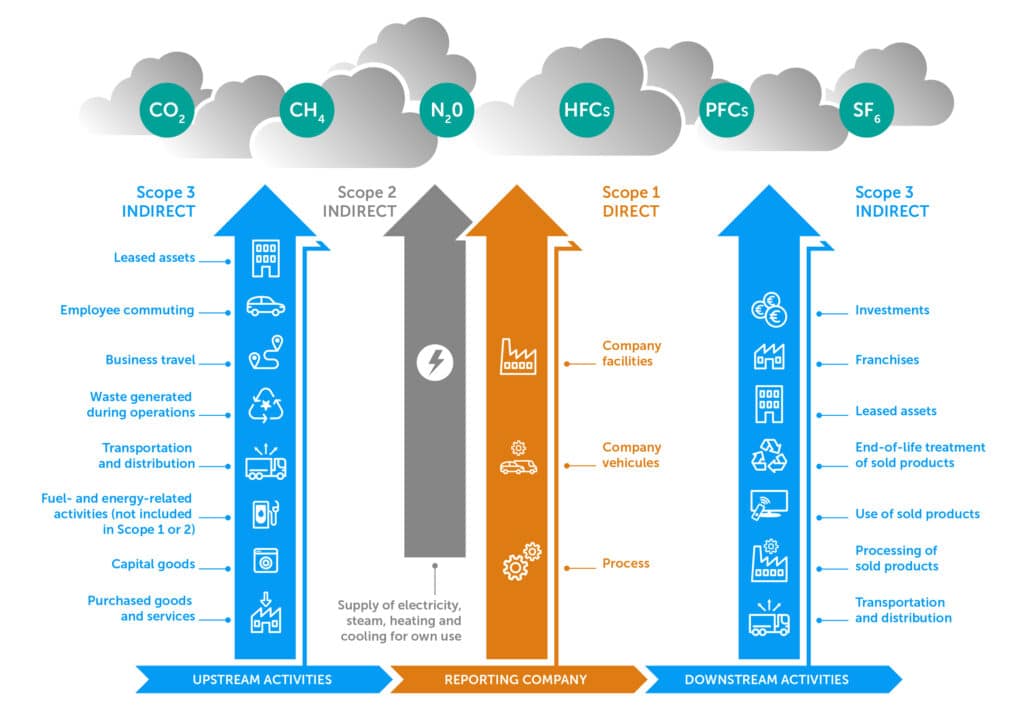
To facilitate the calculation, emissions are classified into three scopes:
Scope 1: Direct emissions. These are emissions for which the company is directly responsible. This includes, for example, fuel combustion in its factories or vehicles, chemical reactions in its industrial processes, and gas leaks in air conditioning systems.
Scope 2: Indirect emissions related to energy. This scope covers emissions associated with the energy consumed by the company, such as electricity or heat. Even if it does not produce these emissions itself, it is responsible for them because it depends on them to operate its activities.
Scope 3: Other indirect emissions. This scope covers emissions that the company influences but does not directly control. They occur upstream and downstream of the company’s value chain. Examples include:
Employees’ commuting: their journey from home to the workplace is linked to the company’s activities.
The use of sold products: this takes place at the customer’s premises but is a direct result of what the company has put on the market.
Waste generated by the company but processed by an external service provider.
The chart below shows the different sources of emissions as defined by the Greenhouse Gas Protocol, with a particular focus on Scope 3, which is often the most complex to track. This scope includes several subcategories covering the entire value chain of a company, from the extraction of raw materials to the use and end-of-life treatment of products.
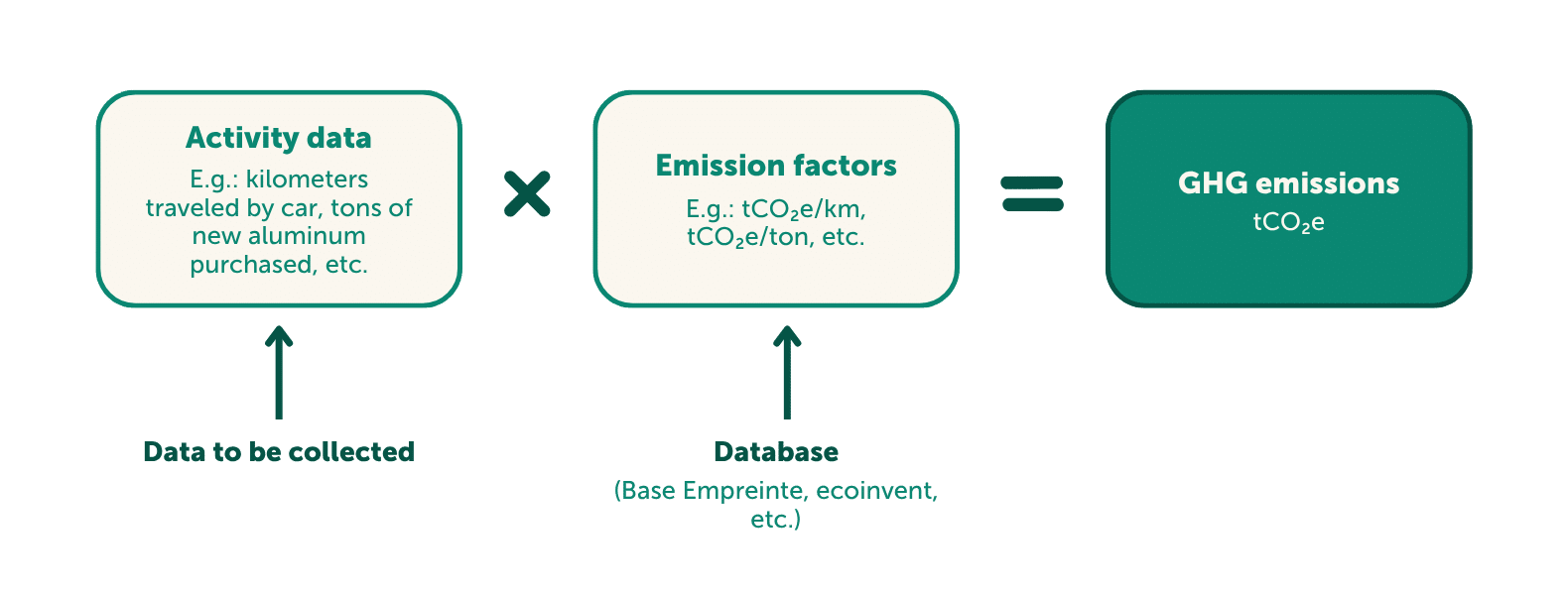
Based on this framework, it is necessary to identify, for each source of emissions, whether the activity data exists, in what form, and who owns it. This data may be actual (physical, e.g. the mass of raw materials purchased, or financial, e.g. expenditure on a service) or extrapolated (from other data, statistics or estimates, such as questionnaires sent to employees). GHG emissions are then calculated by multiplying the activity data by an emission factor.
To be fully effective, the calculation of GHG emissions must result in a transition plan. This plan must include reduction targets and a trajectory, as well as a roadmap outlining emission-reduction measures. Each measure should be specific and quantifiable, with the required resources, deadlines, and responsibilities). Finally, indicators are used to monitor the progress of these measures and the evolution of emissions.
Implementation of measures
Several methods exist to guide this process:
The Greenhouse Gas Protocol: Launched in 2001 by the World Business Council for Sustainable Development (WBCSD) and the World Resources Institute (WRI), this protocol is an international standard for calculating and reporting an organisation’s GHG emissions. It is the most commonly used method internationally.
ISO 14064-1:2018: Developed by the ISO/TC 207/SC 7 technical committee, this standard defines the principles and requirements for organisations to quantify and report greenhouse gas emissions and removals.
To guide you through the various stages, it is advisable to consult an advisor specialising in carbon footprint calculation. They will help you frame the project and collect the relevant activity data. This ensures the accuracy of the emissions calculation and the preparation of the transition plan using appropriate tools (platforms connected to reference databases, with easy and collaborative data entry, automatic allocation to scopes 1-3, simplified updating of data over several years, etc.).
Subsidy application
Government subsidies
Please note: any application for government or non-government subsidies must comply with the “incentive effect”, subject to compliance with the subsidy conditions.
In order to comply with the incentive effect, no binding commitment (signing a quote; paying a deposit) may be made BEFORE submitting the application file or receiving the agreement in principle from the government or the electricity and natural gas supplier following a subsidy application.
Subsidy for small and medium-sized enterprises, covering up to 70% of eligible costs for projects aimed at reducing their environmental impact. The total cost of the project must be between €3,000 and €25,000 excluding VAT.
The Fit 4 Sustainability programme provides co-financing for environmental audits and action plans on one or more topics selected by the company (energy, GHG, waste, water, etc.).
Aid of up to 60%, 70% and 80%, depending on the size of the company, for the fees associated with carrying out an environmental study (energy audit and/or carbon footprint assessment) and a detailed, costed action plan to reduce its consumption/GHG emissions (medium- and long-term investments, ROI, etc.) – open to SMEs and large companies (except those that must carry out studies required by the environmental authorities, including mandatory energy audits)


 Administration
 Agriculture, viticulture
 Aid and care sector
 Commerce
 Craft Industry
 Manufacturing
 Transport